Artificial intelligence is changing the world. But as we move toward a future increasingly shaped by intelligent technology, there's a question I believe we need to be asking: Who gets to build that future, and whose voices will help define it?
It Started With a Question
Why build your own artificial intelligence when companies like OpenAI, Anthropic, Google, and Microsoft already offer some of the most advanced AI systems in the world?
It's a fair question.
We have access to technology that can write, research, analyze information, generate images, develop software, and assist with increasingly complex tasks. Things that once existed primarily in science fiction are becoming part of everyday life.
As a filmmaker, novelist, cybersecurity engineer, and lifelong technology enthusiast, I've always been fascinated by that intersection between imagination and possibility.
But my interest in artificial intelligence eventually led me to a different question.
What if I could build an AI system that operated on my own hardware, followed my requirements, supported my creative work, and gave me greater control over my information?
Not because existing AI platforms aren't useful. I use them myself.
But because I wanted to understand what was possible beyond simply being a customer.
That curiosity became the foundation for A.M.A.R.A. — Aware, Memory, Archive, Relay, Assist.
And what began as a technical challenge has grown into something much more meaningful.
Meet A.M.A.R.A.
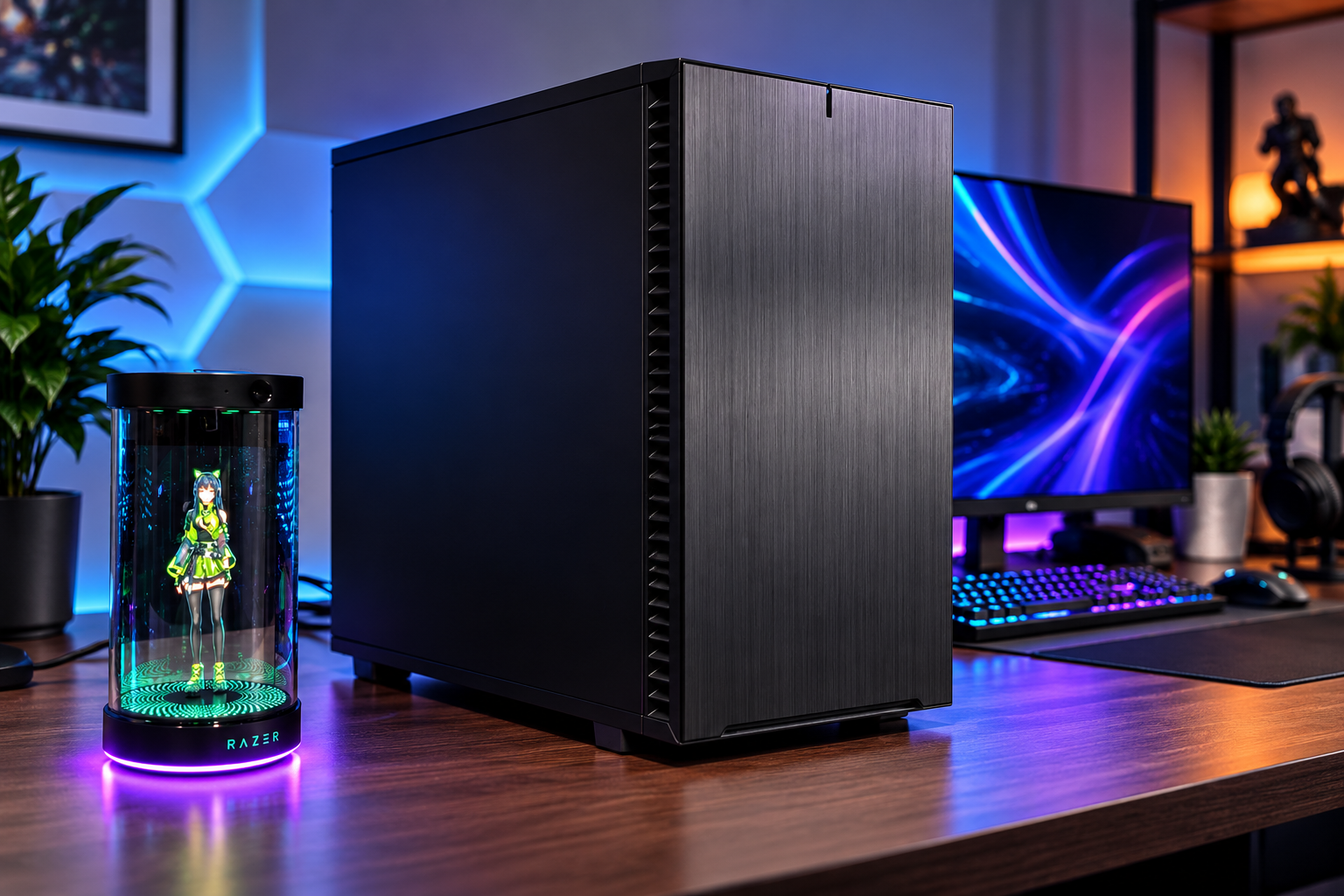
A.M.A.R.A. is my privately hosted artificial intelligence platform, designed to operate primarily on hardware I own and control.
She's being developed as a personal AI assistant capable of helping with research, creative development, information retrieval, knowledge organization, and specialized tasks through a growing system of AI models, memory, tools, and agents.
Unlike a conventional AI chatbot that operates entirely through a company's cloud service, A.M.A.R.A. uses locally hosted language models and supporting applications.
Her architecture brings together AI inference, persistent memory, research tools, document retrieval, automation, and system monitoring.
That doesn't mean every capability I envision is finished. A.M.A.R.A. remains an evolving project, with features being tested, refined, and expanded.
I'm also preparing to move her from the development environment to a dedicated physical server that will provide the computing resources for the next stage of development.
But the hardware isn't the most important part of this story.
The important part is what having that hardware makes possible.
I don't just want access to artificial intelligence. I want meaningful control over the artificial intelligence I use.
And I believe that distinction will become increasingly important.
Why Private AI Matters
Every time we interact with an online service, we make decisions about trust, whether we recognize them or not.
Where is our information going? Who controls it? How long is it retained? What happens when a company changes its policies, pricing, features, or access requirements?
Those questions matter when you're asking an AI to recommend a movie.
They matter a whole lot more when you're sharing business strategies, unpublished manuscripts, financial records, family documents, or intellectual property.
Consider an independent filmmaker developing an original screenplay. Or a small business owner working through a confidential strategy. Or a family organizing decades of photographs, letters, and personal records.
All of that information has value.
Privately hosted AI offers another option. It allows individuals and organizations to run AI models on infrastructure they control, establish their own information-handling rules, and decide which external services, if any, their systems are allowed to contact.
It also opens opportunities for customization that aren't always available through commercial AI products.
Now, private doesn't automatically mean secure. A locally hosted system still needs strong authentication, software updates, encryption, monitoring, backups, and responsible administration.
And connecting a private system to an external AI provider or research service can still involve sharing information outside the local environment.
The difference is that the owner has more opportunities to make those decisions deliberately.
For me, that's an important step toward digital independence.
I'm not suggesting everyone needs a dedicated AI server in their house. Most people won't.
But I do believe people should have choices beyond handing every part of their digital lives to a handful of large technology companies.
Representation Is More Than a Face on a Screen
Now let's talk about something that is especially important to me as a Black American.
Representation.
When people hear that word in connection with artificial intelligence, they might think about an AI avatar that looks like them or a digital voice that sounds familiar.
Those things can have meaning. I understand that personally, because visual identity is part of how I'm developing A.M.A.R.A.
But representation in artificial intelligence goes much deeper than appearance.
It raises questions about who's developing these systems, what information is included in their training data, whose language they understand, what histories they can accurately explain, and what assumptions influence their responses.
And we already have evidence that these questions matter.
In a 2020 Stanford University study examining five major automated speech-recognition systems, researchers found average word error rates of approximately 35% for Black speakers compared with 19% for white speakers.
Think about what that means.
Technology designed to understand human speech performed substantially worse for one group of people than another.
Those findings describe systems tested at that time, not every speech-recognition system available today. But they illustrate a problem that developers must actively work to prevent.
A Pew Research Center survey conducted in 2024 also found that just 19% of U.S. adults believed AI designers took Black adults' experiences and perspectives into account at least somewhat well. For white adults' perspectives, that figure was 40%.
These aren't reasons to reject artificial intelligence.
They're reasons to become more involved in its development.
Because if our perspectives aren't adequately considered when these systems are built, we shouldn't assume they'll automatically understand our experiences when we use them.
And there's no single Black experience that can be captured by an algorithm. Our communities contain different histories, regions, generations, dialects, viewpoints, and traditions.
True representation requires acknowledging that diversity instead of reducing us to a collection of stereotypes.
Who Will Tell Our Stories in the Age of AI?
This is where the conversation becomes personal for me.
As a novelist and filmmaker, I understand the importance of storytelling.
Stories help define how people see themselves and how future generations understand the past.
For Black Americans, the preservation and accurate presentation of our history carries particular significance.
Our history extends far beyond the events most commonly highlighted in textbooks and popular media. It includes generations of scientists, inventors, educators, entrepreneurs, military veterans, artists, families, communities, and everyday people whose contributions deserve to be remembered.
Now imagine a future in which artificial intelligence becomes one of the primary ways people learn about history.
A student asks an AI system about an African American inventor.
A filmmaker researches Black life in the early twentieth century.
A family searches for historical information about its ancestors.
A writer explores the connections between African American history and the broader African diaspora.
Where will those systems get their information? Can they distinguish documented facts from speculation? Will they recognize perspectives that have historically received less attention?
And perhaps most importantly, will the people whose histories are being interpreted have opportunities to contribute to how these systems are developed?
These are questions I've been thinking about while expanding A.M.A.R.A.'s research capabilities.
Part of that work involves developing connections to libraries, archives, museums, historical collections, and other research sources, with particular interest in African American history and the global African diaspora.
The goal isn't to make A.M.A.R.A. an unquestionable authority on our history.
Quite the opposite.
I want her to become better at locating evidence, distinguishing verified information from uncertainty, identifying original sources, and helping people conduct more meaningful research.
Some of those research connections are already operational, while others remain under development or require additional access and validation.
But the direction is intentional.
Our history deserves more than an AI-generated answer that merely sounds convincing. It deserves evidence, context, and respect.
From Consumers to Creators
Here's another reason I believe this work matters.
For years, conversations about technology have often focused on access.
Do people have computers? Can they connect to the internet? Can they learn to use the latest software?
Those are important questions.
But artificial intelligence introduces another dimension.
It's no longer enough to ask whether our communities can use the technology.
We should also be asking whether we're helping design it, whether we're developing businesses around it, whether we're conducting the research, and whether we have opportunities to own what we create.
I want more young Black people to see careers and opportunities beyond the familiar roles they may already associate with technology.
Not everyone has to become a programmer.
We need AI researchers, cybersecurity professionals, data engineers, designers, filmmakers, historians, educators, entrepreneurs, policy specialists, and people who can bring all those disciplines together.
I also want people to understand that building sophisticated technology doesn't always require following the traditional route.
With A.M.A.R.A., I've used my background in information systems and cybersecurity, along with open-source technologies and AI-assisted development tools, to bring together capabilities that would traditionally involve several engineering disciplines.
I've relied on experimentation, research, testing, documentation, and a willingness to revisit decisions when something doesn't work.
Artificial intelligence has helped me accelerate parts of that process.
But it hasn't replaced the need to understand the problem, make architectural decisions, evaluate results, or take responsibility for what gets built.
And that distinction matters.
AI can help lower certain barriers to creating technology. But human judgment, curiosity, discipline, and accountability remain essential.
I want people to look at A.M.A.R.A. and see more than an AI assistant.
I want them to see possibility.
Not necessarily the possibility of building exactly what I've built, but the possibility of developing something meaningful from an idea they once thought was out of reach.
Why This Belongs at Blerd Corner
Blerd Corner exists at an intersection I've always appreciated: Black culture, creativity, imagination, technology, and storytelling.
For me, those interests have never been separate.
Science fiction asks us to imagine possible futures.
Technology gives us tools to explore some of those possibilities.
Art and storytelling help us consider the human consequences.
And culture reminds us that the future doesn't belong to just one group of people.
That's why I believe the conversation about artificial intelligence belongs in creative spaces just as much as it belongs in research laboratories or corporate boardrooms.
AI will influence filmmaking, publishing, illustration, gaming, education, music, and nearly every other creative field.
That brings real opportunities, but also legitimate concerns about intellectual property, employment, consent, artistic identity, and the use of creators' work.
I don't believe the answer is to embrace every new AI product without questioning it.
Nor do I believe we should assume every use of AI is harmful.
I believe we need informed conversations, meaningful safeguards, and people from different backgrounds helping determine what responsible innovation looks like.
At Blerd Corner, I want us to be part of those conversations.
Not just discussing the futures we've seen in movies, comic books, and novels.
But exploring what it takes to build the technologies that may shape our own.
A.M.A.R.A. Is a Beginning, Not a Finished Destination
I want to be clear about something.
A.M.A.R.A. isn't a claim that I've solved the challenges of artificial intelligence.
I haven't.
She's an evolving project. There are technical limitations, ongoing tests, planned features, and decisions that will continue to change as I learn.
She's also a private system, not a publicly available AI service.
As her development progresses, I intend to share selected demonstrations so people can better understand what I'm building and what's possible with privately hosted AI.
Because I believe seeing something work can be more powerful than simply hearing someone describe it.
But the larger purpose isn't to convince everyone to build their own version of A.M.A.R.A.
It's to encourage people to look at artificial intelligence differently.
To ask better questions about privacy.
To think more seriously about ownership.
To demand accountability and accuracy.
To recognize the importance of cultural knowledge and representation.
And to imagine themselves as participants in creating the next generation of technology.
The Future Is Still Being Written
I often think about the generations that came before us.
The people who created opportunities with limited resources, built institutions, preserved culture, developed businesses, and opened doors that hadn't always been open to them.
Innovation has never belonged exclusively to the people with the largest budgets or the most recognizable names.
And the next generation of innovation shouldn't either.
Artificial intelligence will continue evolving, whether we participate in building it or not.
But participation gives us a voice.
It gives us opportunities to question assumptions, create alternatives, preserve what matters, and develop technology that serves needs others may have overlooked.
As a Black American, a veteran, a cybersecurity engineer, and a creative, I see A.M.A.R.A. as one small contribution to that larger conversation.
A personal project with a much broader message.
We don't have to be satisfied with simply watching the future arrive.
We can study it.
We can question it.
We can contribute to it.
And when we have the opportunity, we can build a piece of it ourselves.
The future of artificial intelligence shouldn't simply include us. We should help build it, shape it, and own a part of it.
That's why I created A.M.A.R.A.
And that's why this conversation matters.
About the Author
Coleman Harper is an Army veteran, cybersecurity engineer, filmmaker, novelist, and AI innovator. He is the creator of A.M.A.R.A. (Aware, Memory, Archive, Relay, Assist), a privately hosted artificial intelligence platform. Through Blerd Corner LLC and OmniSpectrum Media Group LLC, his work explores the intersection of technology, creative storytelling, independent innovation, and cultural representation.
Research and References
Stanford University (2020), Automated Speech Recognition Less Accurate for Black Speakers.
Pew Research Center (2025), How the U.S. Public and AI Experts View Artificial Intelligence. Includes the August 2024 public survey.
National Institute of Standards and Technology (2019), NIST Study Evaluates Effects of Race, Age, Sex on Face Recognition Software.
The opinions expressed in this article are those of the author. A.M.A.R.A. is an independently developed, evolving private AI project. Descriptions of future capabilities and demonstrations are not statements of current public availability.