
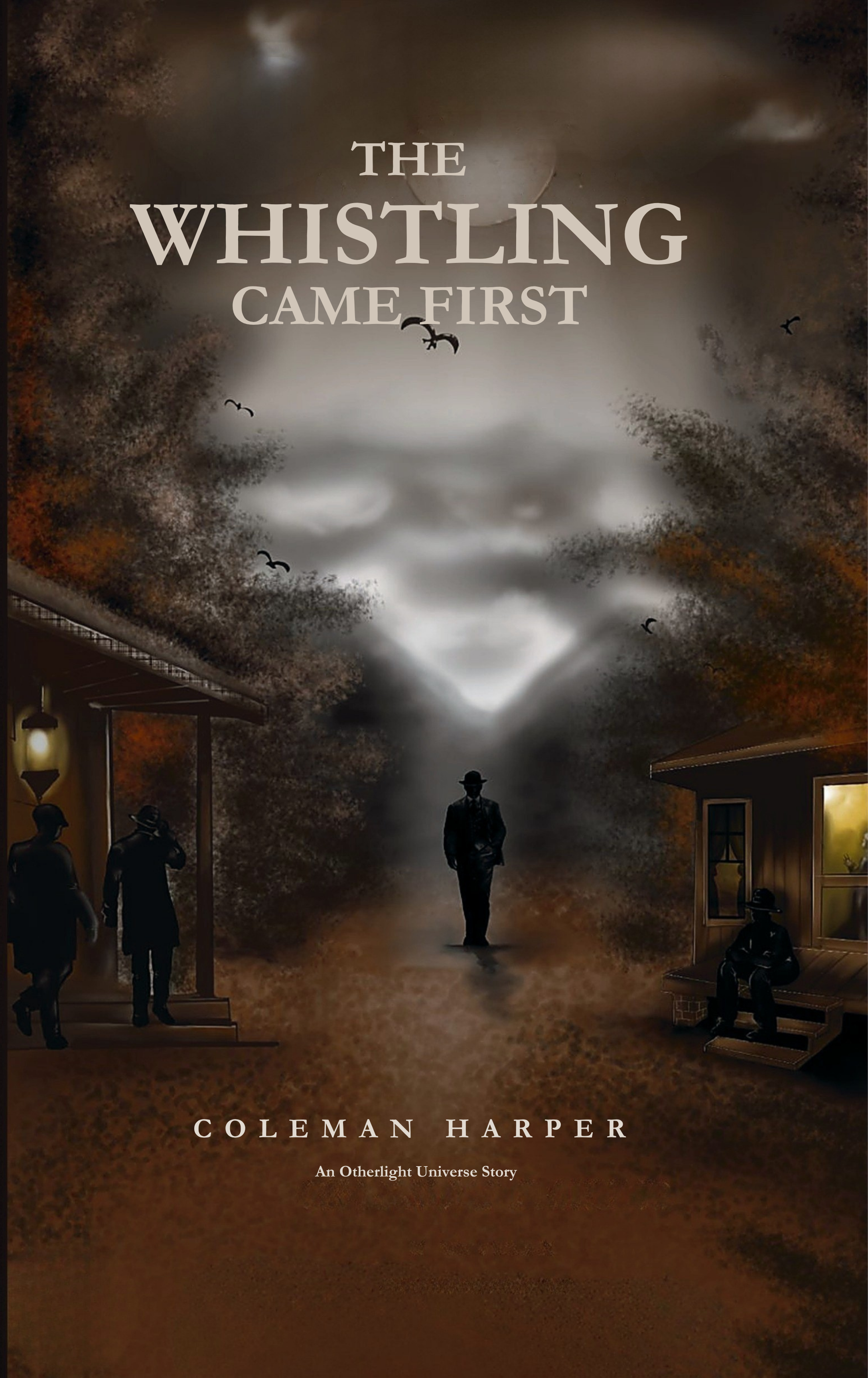
An Otherlight Universe Story
The Whistling Came First
Mastonia, Arkansas. 1926. Some sounds were never meant to be followed.
A vanished Black railroad town. A woman who keeps its names. A stranger who arrives smiling, whistling, and impossibly at ease. In Mastonia, some things were buried. Some were written down. And some should never have followed anyone home.
Launch Sale Pricing
Standard Edition E-Book
$4.99
Special Edition E-Book
$7.99
Instant digital delivery for e-book editions. Print editions available in paperback and hardcover.
Southern Gothic
Supernatural Horror
Southern Gothic Story
Blerd Corner
April 2026
Otherlight Universe
What Waits in Mastonia
A town alive with memory. A whistle no one can ignore.
Mastonia is a place of church suppers, red clay roads, old ledgers, and names people refuse to let disappear. Then something arrives that feels familiar in all the wrong ways.
A town that remembers
Mastonia may be forgotten by the world, but it has not forgotten itself.
A whistle in the distance
It comes low, unhurried, and wrong — the kind of sound that reaches people before they understand why they have gone quiet.
A woman keeping watch
Etta Mae Crawford writes down what matters, even when the world would rather let it vanish.
A stranger at the edge of town
He is charming, immaculate, and impossible to place. No one can agree on what they feel when he smiles — only that they feel it.
Choose Your Edition
Standard Edition
The core story. Best for readers who want the story itself in the cleanest, most direct form.
The complete story
Available as digital bundle, paperback, and hardcover
Ideal for general readers and first-time entry into the story
Available more broadly
E-BOOK
$4.99
$12.99
PAPERBACK
HARDCOVER
$21.99
Special Edition
Choose Your Edition
The story plus the Otherlight Dossier: Mastonia, Arkansas, accessed through an exclusive QR code printed in the back of the book. Best for readers who want to go deeper into what the land remembers
The complete story
The Otherlight Dossier included with the edition
Available as digital bundle, paperback, and hardcover
Sold only through Blerd Corner and Lulu Bookstore
E-BOOK
$7.99
$15.99
PAPERBACK
$24.99
HARDCOVER
The Special Edition is only available through Blerd Corner and Lulu Bookstore, and it carries readers deeper into the record, the silence, and what Mastonia remembers through the Otherlight Dossier, accessed by QR code in the back of the book
About the Book
A forgotten town. A ledger full of lives. A whistle that sounds like a warning too late.
In 1926, Mastonia is still alive — church suppers, red clay roads, children in the yard, quartz catching the light, and Etta Mae Crawford at her table making sure no one is lost to forgetting.
But when a stranger appears and a strange whistle begins moving through the trees at night, the calm rhythm of the town starts to shift. Old fears stir. Silences deepen. And Etta Mae begins to sense that memory alone may not be enough to protect what remains.
The Whistling Came First is a Southern Gothic story of place, dread, and the kind of quiet danger that arrives smiling.
Step into Mastonia.
Read an Excerpt
Start with the opening pages of The Whistling Came First and meet Etta Mae Crawford before the whistle begins working its way through the trees.
-
Part One: The Town Alive
Chapter 1
The Keeper
The heat sat on Mastonia like a hand that didn’t ask permission. But the town was used to things that didn’t ask.
Etta Mae Crawford wiped her forehead with the back of her wrist and turned another page of her ledger, the leather cover worn soft from forty years of handling. Across the table, Mother Jessup was still talking—had been talking for the better part of an hour—her voice rising and falling like creek water over stones.
“—and that’s when Cornelius said to the man, he said, ‘Sir, I don’t know what you paid for that mule, but you were robbed twice: once for the money and once for the trouble.’ And the whole market just fell out, Etta Mae. Fell out laughing. You could hear it all the way to the rail station.”
Etta Mae smiled, her pen moving steadily. At sixty-two, her hands weren’t as steady as they’d once been, but they still knew this work—the careful loops of letters, the weight of a name pressed into paper. She’d been keeping the ledger since she was twenty-two, when her grandmother had placed the blank book in her hands and said, Someone has to remember.
Someone has to write it down.
That first morning, Etta Mae had sat in this same position—different chair, different table, but the same quality of light slanting through a window—and felt the weight of the empty pages like a physical thing pressing against her chest. Her grandmother’s hands had guided hers through the first entry. The ink had smelled of iron and oak galls, dark as old blood, and when the nib touched the page it made a sound like a whisper beginning. Her grandmother had mixed that ink herself from a recipe passed down through three generations, a recipe that started somewhere across the ocean in a place that had different names now, a place her grandmother’s grandmother had been stolen from before anyone thought to write down exactly where.
The pen she used now was the third one. The first had belonged to her grandmother—a simple wooden holder with a steel nib that had to be dipped every few words. That one rested in a velvet-lined box in Etta Mae’s bedroom, too precious for daily use. The second had been a gift from Samuel, Sonny Ray’s brother, before he went north. He’d saved for months to buy it—a proper fountain pen from a catalog, the kind white folks used. She’d written with it for fifteen years until the mechanism wore out, and now it sat beside the first in that same velvet box, keeping company with ghosts.
This pen was practical. Steel nib, wooden holder, nothing fancy. But it did the work. The work was what mattered—not the prettiness of the tool but the permanence of what it left behind.
“Cornelius always did have a mouth on him,” Mother Jessup said, softer now. “Lord, I miss that man.”
“He’s in here now.” Etta Mae turned the ledger so the old woman could see. “Right next to your wedding date and the year your first child was born. He’s not going anywhere.”
Mother Jessup reached out and touched the page with trembling fingers. The ink was still wet.
“You do good work, child,” she said. Even at eighty-one, she still called Etta Mae “child.” Everyone did. The Keeper of Names was everyone’s child, everyone’s responsibility. “Holy work.”
Through the open window, the sounds of Mastonia drifted in: the clang of Silas at his forge, children’s voices from the direction of the schoolhouse, the rhythmic thump of someone beating a rug on a porch rail. A warm breeze carried the smell of pine resin and honeysuckle and the faint mineral tang of the creek.
On the windowsill, a chunk of quartz caught the afternoon light.
Etta Mae’s eyes lingered on it longer than usual. Mother Jessup had given her that piece years ago—pulled from the creekbed after a hard rain, when the water ran fast enough to turn up what the earth had buried. It wasn’t the clearest crystal, not the kind the rock hunters from Hot Springs paid money for. But it held light in a particular way, throwing small rainbows across the kitchen when the sun hit it just right. Her grandmother had believed the quartz remembered things—that if you sang into a crystal, your voice would live there forever, echoing in the stone’s heart long after your throat had gone to dust. Etta Mae wasn’t sure she believed that. But she kept the crystal anyway, and sometimes, late at night when sleep wouldn’t come, she held it to her ear and listened for the voices of the dead.
Etta Mae closed her ledger and stood, her knees protesting the hours she’d spent on Mother Jessup’s hard kitchen chair. “I should let you rest. Sonny Ray’s expecting me at the store before supper.”
“That man.” Mother Jessup shook her head, but she was smiling. “Still looking after you after all these years.”
“He runs the store. I run the ledger. We have an arrangement.”
“Mmm-hmm. Forty years, that arrangement’s been running. Some arrangements got a different name.”
Etta Mae kissed the old woman’s forehead and stepped out into the August heat.
Mastonia had no official founding date. It had simply accumulated, the way silt accumulates at the bend of a river—slowly, persistently, until one day there was enough to stand on.
The oldest building was the church, built in 1871 by men who had been property six years before. They had hauled the lumber themselves, cut from pines they now owned, and raised the walls in a single weekend while their wives sang hymns and their children played in the red clay dust. The bell had come later—a gift from a white church in Little Rock that was replacing theirs with something larger. It had a crack in it that made the tone slightly flat, but no one in Mastonia minded. They said the crack gave it character. They said it sounded like a voice that had been through something and come out the other side.
The general store had been Sonny Ray’s father’s before it was Sonny Ray’s. The schoolhouse had educated three generations of children who went on to become teachers and doctors and lawyers in cities that had never heard of this place. The blacksmith shop still rang with the sound of Silas’s hammer, and the smell of hot iron drifted across the town square on windless afternoons, mixing with woodsmoke and honeysuckle and the particular green scent of the creek.
There was a rhythm to Mastonia that outsiders never understood. The way the women gathered at the well on Tuesday mornings, not because they needed water but because they needed each other. The way the men played dominoes on Ezra’s porch every Saturday, the click of tiles punctuating arguments about politics and crops and the inexplicable behavior of wives. The way the whole town fell silent at dusk, just for a moment, as if pausing to acknowledge the day’s passage.
Two hundred and thirty-seven souls. That was what Etta Mae’s ledger said. Two hundred and thirty-seven people with names and histories and the small daily heroisms that never made it into anyone’s record except hers. She knew them all. She had written them all down.
And she could not shake the feeling that something was coming to take them away.
The road through Mastonia was red clay packed hard by decades of feet and wagon wheels and, once, the iron wheels of trains that no longer came. Etta Mae walked it the way she’d walked it all her life, nodding to faces she knew, calling out names she’d written down.
She thought about Tulsa, like she did sometimes when the sun was too bright and the world felt too fragile. Five years ago, Black Wall Street had burned. Thirty-five blocks of prosperity, gone in a night. She’d written down every name she could find in the papers—the dead, the displaced, the disappeared. It wasn’t her town, but it was her people, and she couldn’t bear the thought of them being forgotten.
And before that, Elaine. 1919. Just seven years back and barely a hundred miles east. They said between one hundred and eight hundred Black folks had been killed in Phillips County—the number changed depending on who was counting and who was being allowed to count. She’d written those names too, the ones she could find, the ones anyone remembered.
Mastonia had survived. Mastonia had always survived. But Etta Mae knew how thin the walls were between surviving and not.
The heat pressed down on her shoulders like a physical weight. Cicadas screamed from the tree line, their chorus rising and falling in waves that seemed to pulse with the afternoon sun. The red clay dust coated her shoes, worked its way into the creases of her skin, settled on the ledger bag until it looked rust-colored instead of brown. This was the texture of her life—the constant fine grit of this place working its way into everything she touched, everything she was. The land marked you whether you wanted it to or not.
She had thought about leaving, once. Back when she was young enough to believe that somewhere else might be better. Chicago. Detroit. Places where the factories were hiring and a Black woman with good penmanship might find work that paid real money. But her grandmother had looked at her with those ancient eyes and said nothing, and somehow that silence had said everything. The silence had held forty years of keeping. The silence had held a thousand names. The silence had known something about roots that Etta Mae was still learning.
“Afternoon, Deacon Willis.”
“Miss Etta Mae.” He tipped his hat. He had a suitcase at his feet—Deacon Willis was always heading to the next county for something, lumber or nails or hymnals. Half the time he was gone more than he was home. “How’s the ledger?”
“Getting fuller every day.”
Henry Bessemer sat on his porch the way he did every afternoon, watching the light change on the ridge. Ninety years had taught him patience. Ninety years had taught him a great many things, most of which he would rather not have learned.
He had been born in a cabin in Georgia with no windows and a dirt floor. His mother had sung to him in a language she was not supposed to know, words she had carried across the ocean in the only place they couldn’t be taken from her—the space behind her teeth, the hollow of her throat. She had taught him those songs before she was sold away, and he had kept them the way you keep a coal burning through a long night: carefully, secretly, with the knowledge that everything depended on not letting it go out.
He had been twenty-five when the war came. Twenty-nine when it ended. He remembered the morning the news arrived—remembered the way the overseer’s face had gone white as milk, remembered the silence that spread across the fields like something holy. He had walked off that plantation with nothing but the clothes on his back and the songs in his chest, and he had kept walking until he found a place that felt like it might let him stay.
Mastonia had let him stay for fifty-five years now.
Though lately, Mastonia had started to slip. Some mornings Henry woke and couldn’t remember if his wife had died last winter or thirty years ago. Some afternoons he found himself standing in the middle of a room with no memory of why he’d come there, the present moment untethered from the moments before it. Time had become a river he couldn’t trust—sometimes flowing smooth, sometimes doubling back on itself, sometimes vanishing underground only to resurface somewhere unexpected.
He watched Etta Mae Crawford making her way up the road, her ledger bag over her shoulder, and he raised a hand in greeting. She waved back. Good woman. Doing good work. Writing down the names so they couldn’t be erased, the way his mother’s name had been erased, the way so many names had been erased before anyone thought to record them.
Henry closed his eyes and let the afternoon sun warm his face. The songs remained, even when everything else clouded and slipped. The songs were older than his memory. They didn’t need him to remember them—they remembered themselves, living in his throat the way water lives in a well, always there when you reach for it.
He hummed a few bars of something ancient. The ridge listened. The quartz in the mountain held the sound and kept it.
Past the church with its whitewashed steeple. Past the general store where Sonny Ray was hauling sacks of flour through the side door, his broad shoulders straining against his suspenders despite his fifty-seven years. Past the old Crawford place—her grandmother’s house, her house now—with its porch swing and its garden and the chunk of quartz on the threshold that her grandmother had placed there forty years ago, for luck, for memory, for reasons the old woman had never quite explained.
Two children ran past, nearly knocking her into the ditch.
“Isaiah Thibodeaux, you slow down before you break something!”
The boy skidded to a halt, gap-toothed grin flashing. “Sorry, Miss Etta Mae!”
Behind him, Josephine Bell walked at a measured pace, her lips moving silently. Counting steps, probably. The girl counted everything.
“How many today, Josephine?”
“Two hundred and forty-seven from my house to the store,” Josephine said. “Two hundred and fifty-one if you go around the mud puddle.”
“That’s important information. I might have to write that down.”
Josephine’s serious face broke into something almost like a smile.
Etta Mae watched them go—Marcus already running again, Josephine maintaining her steady pace—and felt the weight of the ledger in her bag. Every name in Mastonia was in those pages. Every birth, every death, every marriage and baptism and story worth remembering. She’d started the ledger forty years ago, convinced that writing things down meant they couldn’t be taken from you.
Four decades later, she still believed it.
The leather of the bag had molded itself to her shoulder over the years, shaped itself to the particular curve of her body the way a good shoe shapes to a foot. She could feel the ledger’s weight shifting with each step—a solid, comforting presence, like carrying a child on her hip. The book held seventeen hundred and forty-three names now. Some were crossed through—the dead, the moved-away, the vanished. Some had asterisks beside them, notes in her careful hand about things that mattered: first schoolteacher to graduate from normal college, built the bridge over Crooked Creek, delivered three babies during the ice storm of ’08. The small facts of lives that would otherwise dissolve into time’s great amnesia.
The ridge line to the west was going purple with evening. Somewhere in the hills, the quartz veins that ran through this land like frozen lightning were catching the last of the light.
She shifted the ledger to her other shoulder and walked on toward the store.
Why Readers Get Pulled In
Readers who love
Haunted places that remember
Southern Gothic atmosphere with real emotional stakes
Folklore, dread, and slow-building supernatural tension
Black history, community, and memory woven into horror
What this story promises
A powerful woman at the center of a threatened town
A place that feels alive before the danger reveals itself
A stranger whose charm never feels safe
A mystery rooted in memory, silence, and what refuses to stay buried
Buy from the imprint. Stay closer to the world.
Instant access to digital editions
Access to the exclusive Special Edition
Support the imprint directly
Stay connected to future Otherlight releases
Why Buy Direct
Blerd Corner
Independent imprint focused on myth, memory, folklore, and stories rooted in the African diaspora.
Founded by Coleman Harper.
The Whistling Came First is part of the Otherlight Universe.
From the Imprint
Frequently Asked Questions
-
The Standard Edition is the core story. The Special Edition includes the story plus the Otherlight Dossier: Mastonia, Arkansas, accessed through an exclusive QR code printed in the back of the book.
-
No. The Special Edition is available only through Blerd Corner and Lulu Bookstore.
-
Digital Editions are delivered after purchase.
-
The Otherlight Dossier is accessed through an exclusive QR code printed in the back of the Special Edition.
-
Yes, The Whistling Came First part of the Otherlight Universe.