Building a 12-Lens Vintage Nikkor AI-S Cinema Set Under $5,000
Twelve vintage Nikkor AI-S lenses, carefully sourced one at a time over four years and fully cine-modded for use across modern cinema camera systems. More than a collector’s set, this is a working cinematography package built for narrative texture, rich image character, darker skin tones, and long-term creative ownership.
Don’t have time to read the full breakdown? Listen to the summary first, then use the written article for the full lens list, cost breakdown, and build notes.
In this build breakdown, I cover why I chose Nikkor AI-S glass, how I cine-modded the set, what each lens does, how the kit supports darker skin tones, and what the full build cost.
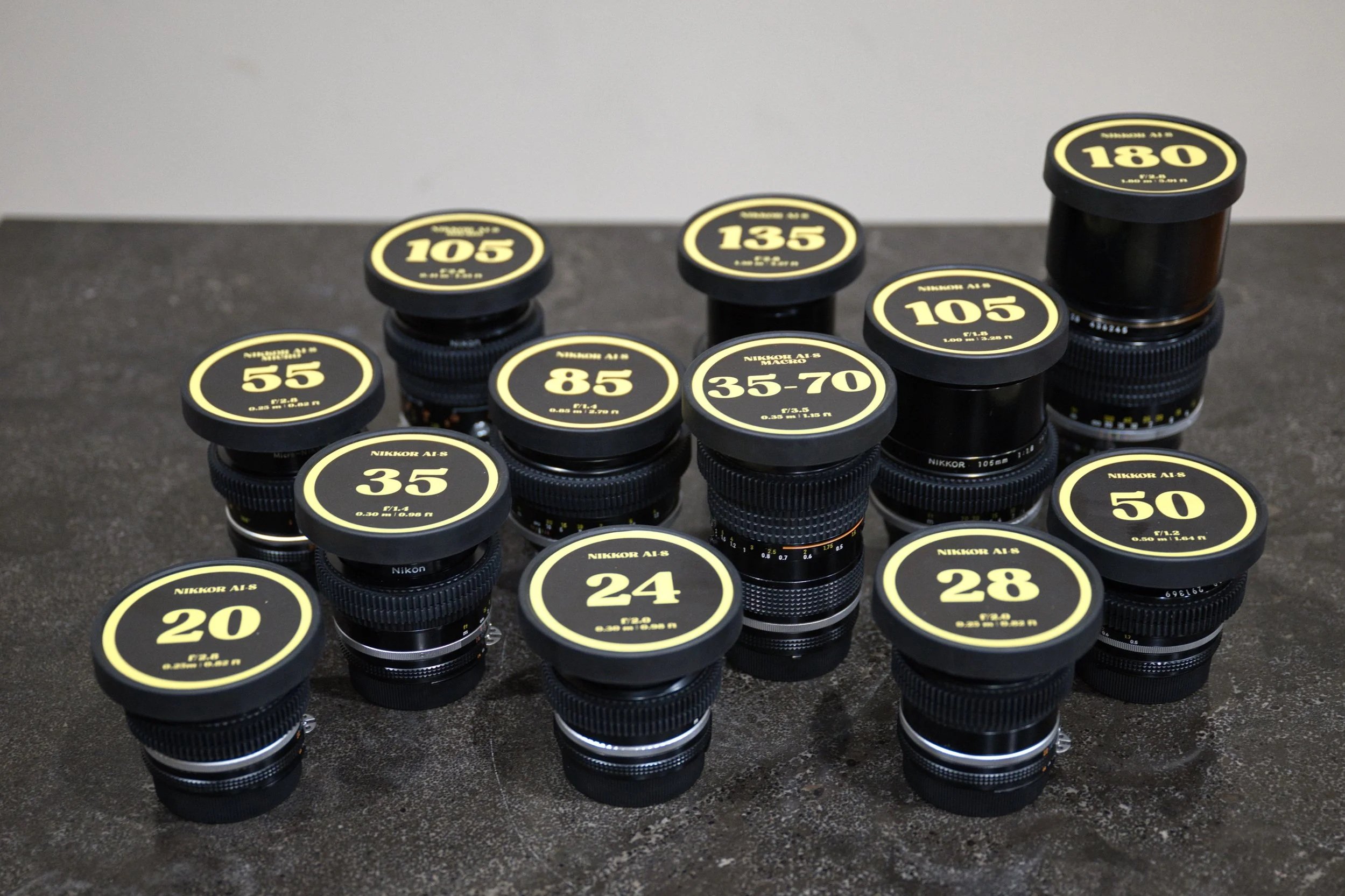
The set. Twelve Nikkor AI-S lenses, eleven primes and one zoom, capped with the custom black-and-yellow labels.
Why This Set Exists
I shoot on two bodies. The Nikon ZR records internal R3D NE, Nikon’s RED-derived RAW format, for client and production work. The Blackmagic PYXIS 6K is the narrative cinema body — full-frame, L-mount, run fully manual with adapted AI-S glass, shot OpenGate.
OpenGate means the sensor runs uncropped: 6048×4032 at 3:2, capturing the full imaging area so I can reframe to any delivery aspect ratio in post. Cam Mackey has been one of the clearest voices advocating for OpenGate as a working professional discipline — his video “OpenGate: Why Working Professionals Disagree with YouTubers” sharpened how I think about it.
A PYXIS 12K is next — same philosophy, more resolution. The camera does not care what glass is on the front. That freedom is the point.
The lenses I chose are twelve Nikkor AI-S lenses — eleven primes and one utility zoom — ranging from 20mm to 180mm, sourced over four years from MPB, KEH, and eBay. All-metal construction, fully mechanical, forty-plus years old. No autofocus. No electronic contacts. Every one of them owned outright.
Spencer Chumbley’s article on building a Nikkor AI-S prime set was the framework. He proved a full vintage cinema kit could be built for under $5,000 and hold its own against glass costing ten times more. I took his structure and built from it — different camera system, different adapter, different purpose.
My set is built for narrative and brand cinematography through Blerd Corner. It feeds the Otherlight Universe — more than twenty-six interconnected stories rooted in African diasporic spirituality, historical trauma, cosmic horror, and community erasure.
The glass needs texture, warmth, and presence. It needs to put something into the image instead of stripping everything out. Modern cinema lenses are engineered to disappear. These lenses are not.
Total lens investment: $4,064.25. Full cine-mod all-in: $4,797.67.
Who This Build is For
This build is for filmmakers, photographers, and owner-operators who want to own their image instead of renting one.
It is not a beginner autofocus kit. It is not built for speed above intention. This is a manual cinema lens system for people who care about texture, skin tone, mechanical control, and long-term creative ownership.
If you shoot narrative work, brand films, interviews, product details, book promos, or visual stories where the image needs character instead of clinical perfection, this kind of set makes sense. It rewards patience. It rewards practice. And once it is built, it belongs to you.
Why Nikkor AI-S
There are other vintage lens ecosystems — Leica R, Contax Zeiss, Canon FD, Minolta Rokkor. All capable glass. I looked at all of them. The Nikkor AI-S line won on every criterion that mattered to me.
They are fully mechanical. Physical aperture ring, smooth focus helix — no fly-by-wire, no electronic contacts, nothing between my hand and the glass. On a manual cinema rig, that is not a preference. It is a requirement. I need to pull iris and ride focus without wondering what firmware is doing behind the scenes.
They are fast. The 50mm f/1.2, the 35mm f/1.4, the 85mm f/1.4, the 105mm f/1.8, the 135mm f/2.8 — nearly every lens in this set is at or near the fastest aperture Nikon ever produced at that focal length. That is not a spec sheet exercise. It means low-light narrative work, shallow isolation in tight spaces, and the kind of bokeh that makes vintage glass worth the trade-offs against modern optics.
They have character without being undisciplined. The AI-S line sits between vintage softness and modern clinical correction. Wide open, the faster primes render warm, slightly low-contrast images. Highlights bloom. Edges soften. Halation wraps around practical lights like something half-real.
Stopped down, they sharpen up and behave. I can dial the look with the aperture ring — dreamy at f/1.4, controlled at f/4 — on the same lens, in the same shot. That range matters when the work demands both atmosphere and precision.
They are affordable and available. These lenses were manufactured for decades, and the used market is deep — MPB, KEH, and eBay have consistent inventory at every focal length. I built a complete twelve-lens set for $4,064 over four years as the right copies appeared at the right prices. The ecosystem rewards patience.
They accept cinema modifications without resistance. All-metal construction, uniform mechanical design across the line, no electronics to work around. A Tilta ring slips on the focus barrel. An 80mm OD step-up ring threads onto the filter. A push-on cap seats flush. Nothing fights you. I geared, standardized, and capped all twelve lenses myself — no machine shop, no technician, no send-away service.
Rendering Darker Skin
Everything in this system — the lens selection, the exposure methodology, the three-pass color grade — exists to serve one priority: rendering darker skin tones with accuracy, warmth, and dignity. This is not an afterthought. It is the reason the system was built this way.
The film industry has a documented history of failing darker-skinned subjects. Metering calibrated to 18% gray. Lighting designed around lighter complexion as the default. Film stocks balanced to render European skin as “neutral.” Digital cameras are better than their predecessors, but the defaults still carry those assumptions.
That is starting to change at the highest levels. Autumn Durald Arkapaw’s cinematography on Ryan Coogler’s Sinners (2025) — shot on 15-perf IMAX 65mm and 5-perf Ultra Panavision 70, using Panavision Ultra Panatar 1.3x anamorphics customized by Dan Sasaki — won the Academy Award for Best Cinematography.
She was the first woman, and the first woman of color, to win in the category. Her hero lens was the 50mm Ultra Panatar, and one of her signature moves is deliberately underexposing the foreground to protect highlight detail in the grade. The choices she made at the studio scale — intentional glass, deliberate rendering of Black skin, story-driven format choices — are the same choices this system is built around.
This system corrects at every stage.
At the lens. Vintage Nikkor AI-S glass renders skin with warmth and organic rolloff. The slight low-contrast wide-open character wraps around darker complexions instead of flattening them. That is not an accident of old glass — it is why I chose it over clinically corrected modern optics.
At the grade. The pipeline runs three passes in DaVinci Resolve.
First pass: technical — normalize exposure, white balance, and color matching across the PYXIS 6K’s dual native ISO (400/3200).
Second pass: lens-match — per-lens correction nodes built from color chart and skin tone references shot at working apertures.
Third pass: creative look — lifted blacks, warm midtones, cool shadow shift, organic highlight rolloff.
Every lens renders melanin differently — different warmth, different contrast in the midtones, different behavior in the shadows. A blanket LUT does not solve that. Per-lens nodes built from controlled reference charts do.
The 35mm f/1.4 is the grade reference lens. It sits in the middle of the set — in focal length, in rendering character, in warmth. Everything else gets graded toward it.
Two lenses need specific attention. The 50mm f/1.2 runs warm and low-contrast wide open. On darker skin tones, it pushes warm-golden — which can work, but it needs control or it overdrives. The 180mm f/2.8 ED is the opposite problem. ED glass makes it the sharpest and most clinically corrected lens in the set. Intercutting it with the other primes without treatment looks wrong. It needs subtle contrast reduction and a touch of halation to sit in the same visual world.
The 12-Lens A-Set
Eleven primes and one utility zoom.
Every lens is an AI-S. Most are the fastest AI-S version at their focal length; the Micro lenses and the 35–70 Macro are included for their specific utility roles. Every lens is owned.
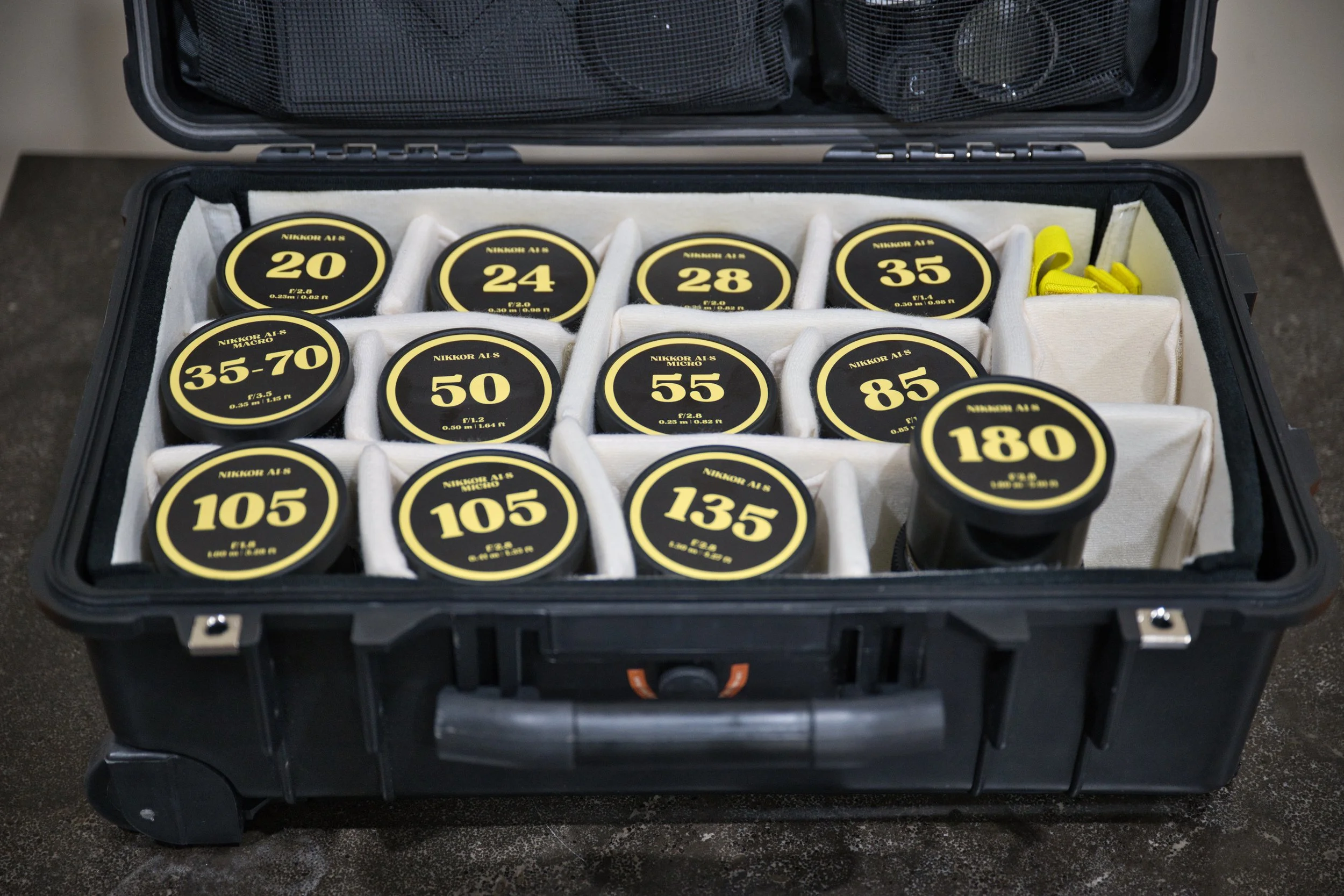
Twelve lenses in the Apache 5800. 20–180mm, eleven primes, one zoom, organized by focal length.
| Lens | f/ | Filter | Price Paid |
|---|---|---|---|
| NIKKOR 20mm f/2.8 AI-S | 2.8 | 62mm | $299.99 |
| NIKKOR 24mm f/2.0 AI-S | 2.0 | 52mm | $299.98 |
| NIKKOR 28mm f/2.0 AI-S | 2.0 | 52mm | $240.00 |
| NIKKOR 35mm f/1.4 AI-S | 1.4 | 52mm | $474.99 |
| Zoom-NIKKOR 35-70mm f/3.5 Macro AI-S | 3.5 | 62mm | $167.55 |
| NIKKOR 50mm f/1.2 AI-S | 1.2 | 52mm | $499.00 |
| Micro-NIKKOR 55mm f/2.8 AI-S | 2.8 | 52mm | $169.60 |
| NIKKOR 85mm f/1.4 AI-S | 1.4 | 72mm | $617.98 |
| NIKKOR 105mm f/1.8 AI-S | 1.8 | 62mm | $539.74 |
| Micro-NIKKOR 105mm f/2.8 AI-S | 2.8 | 52mm | $293.28 |
| NIKKOR 135mm f/2.8 AI-S | 2.8 | 52mm | $177.19 |
| NIKKOR 180mm f/2.8 ED AI-S | 2.8 | 72mm | $284.95 |
| Total lens investment | $4,064.25 |
The set was sourced from MPB, KEH, and eBay over 2022–2026. Two bench lenses — a 35mm f/2 AI and a 50mm f/1.4 AI, both purchased May 2022 — started the collection and were replaced when I upgraded to the faster AI-S versions. They are retained as backups.
Filter Thread Families
| Thread | Lenses |
|---|---|
| 52mm | 24mm f/2, 28mm f/2, 35mm f/1.4, 50mm f/1.2, 55mm f/2.8 Micro, 105mm f/2.8 Micro, 135mm f/2.8 |
| 62mm | 20mm f/2.8, 35-70mm f/3.5 Macro, 105mm f/1.8 |
| 72mm | 85mm f/1.4, 180mm f/2.8 ED |
What Each Lens Does
Finishing the Set
Cine-modding stills lenses means making them behave on a cinema rig. For this set, that is four things: an adapter, follow focus gears, standardized front outer diameter, and proper case storage. Here is every component, every vendor, and every dollar.
Adapter — Urth Nikon F to Leica L
The entire set mounts to the PYXIS 6K through a single Urth Nikon F-to-Leica L passive mechanical adapter. Precision-machined fit, anti-reflective matte interior, no optical interference. Machined from warp-resistant aluminum. Lifetime warranty.
No electronics, no AF coupling — just a solid mechanical connection between the F-mount lens and the L-mount body. That is all you need with AI-S glass.
Urth Nikon F to Leica L Adapter — $65.00
Follow Focus Gears — Tilta Seamless (0.8 MOD)
Every lens gets a Tilta Seamless Focus Gear Ring. Rubber construction, seamless — no screws, no seams. Industry-standard 0.8 MOD pitch. They slip onto the focus barrel and hold by friction.
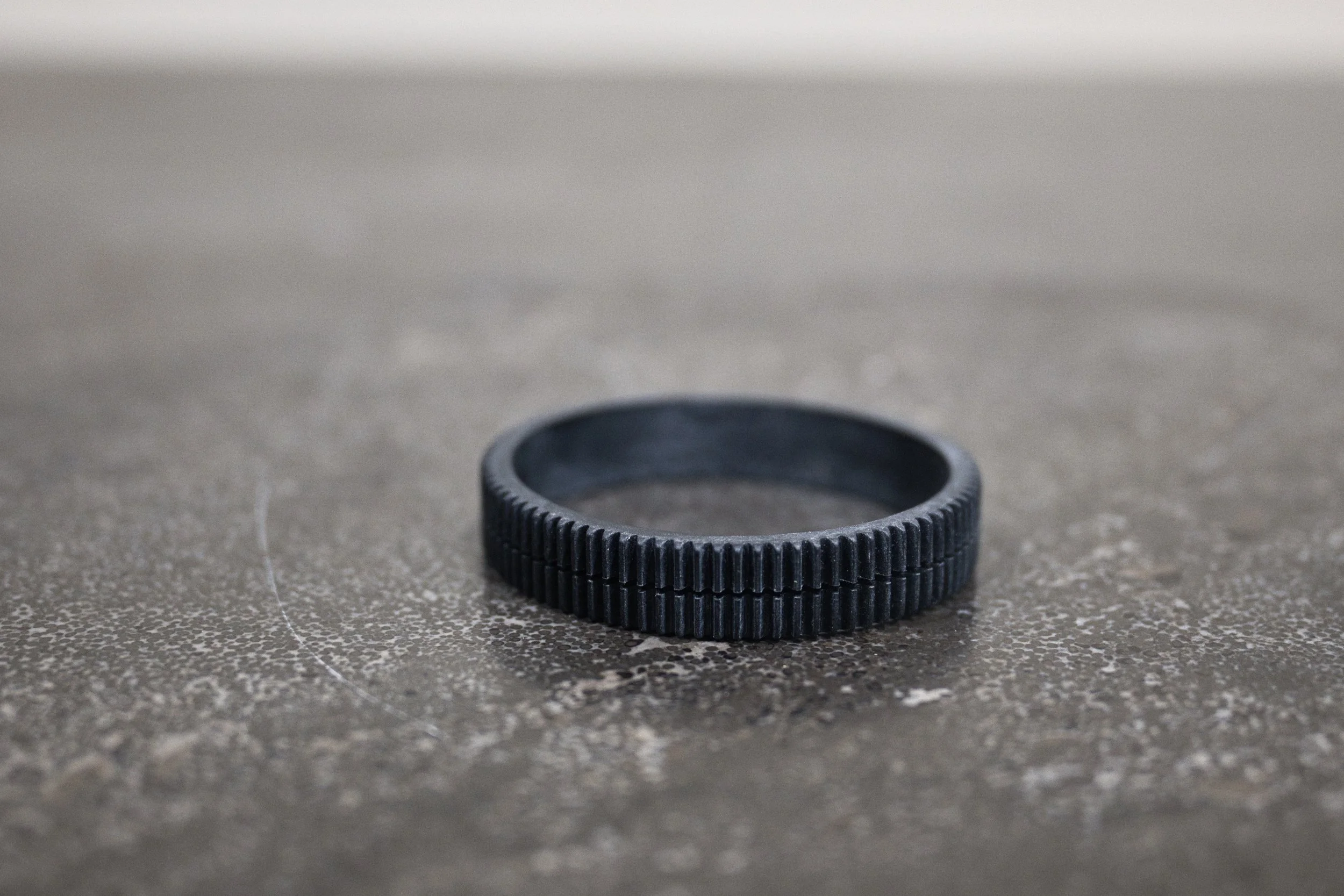
Tilta Seamless Focus Gear Ring — 0.8 MOD pitch, rubber construction, no seams. One of twelve in the kit.
One rule: do not order by filter thread size. The ring fits the outside diameter of the focus barrel, not the filter thread. Those are different numbers. Measure each lens with calipers at the exact location where the ring will sit. Tilta sizes come in 2mm increments — 59–61mm, 62.5–64.5mm, and so on. Get it right or the ring does not hold. I keep a caliper in the kit. It is part of the standard loadout.
| B&H — Order Total Paid: $29.43 | |
|---|---|
| Item | Qty |
| Tilta Seamless Focus Gear Ring (62.5–64.5mm) | 6 |
| Tilta Seamless Focus Gear Ring (66–68mm) | 3 |
| Tilta Seamless Focus Gear Ring (78–80mm) | 3 |
Twelve rings for a total order cost of $29.43 — about $2.45 per ring at the time of purchase. Pricing fluctuates, so verify current pricing before ordering. The 35–70mm f/3.5 Macro requires measurement on the focus barrel to confirm fit, with clearance checked through full zoom and macro travel.
I will replace the Tilta gears with Simmod SIMple Fit focus gears later. Simmod’s aluminum gears are more precise and more durable, and they publish gear sizing data for the 35mm f/1.4 and 50mm f/1.2 specifically. The Tiltas are the starting point. They work. The upgrade comes when it makes sense financially.
80mm OD Front Rings & Caps — FollowFocusGears.com
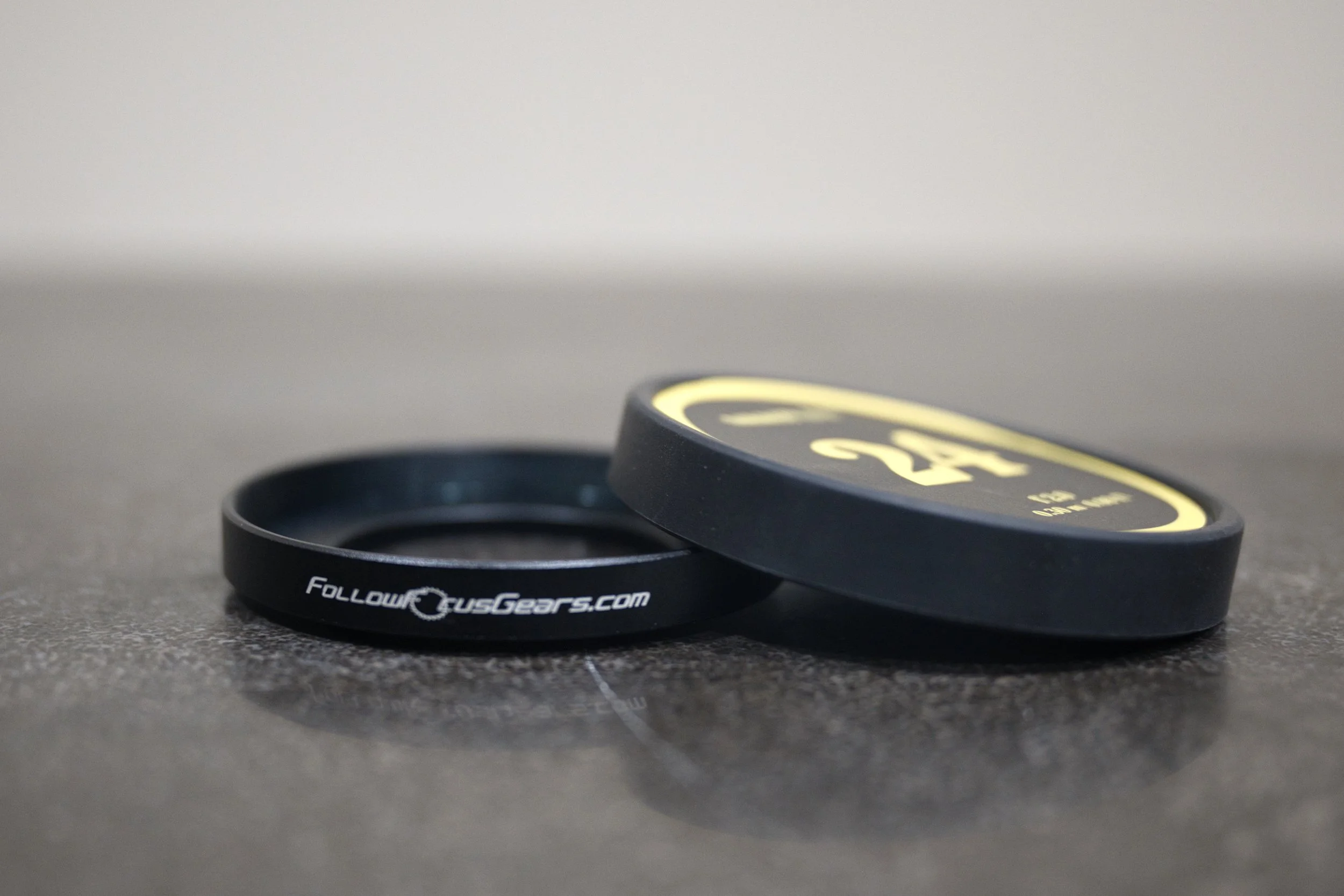
FollowFocusGears.com 80mm OD step-up ring (52–77mm shown) and matching custom slip-on cap. Same treatment across all twelve lenses.
The twelve lenses have three filter thread families: 52mm (seven lenses), 62mm (three lenses), and 72mm (two lenses). Without standardization, that is three different matte box setups and no way to identify a lens at a glance when the cap is off.
The fix is 80mm OD step-up rings. They thread onto the existing filter thread and bring every lens to a uniform 80mm outer diameter. One matte box size. One cap size. One system.
The 35–70mm f/3.5 Macro is the one exception. Its front rotates during focus, so the 80mm OD ring standardizes the cap size and front diameter, but it is not ideal for a clamp-on matte box during focus pulls.
I used FollowFocusGears.com. They carry the same type of 80mm OD cine rings and caps as Cordvision and Simmod, and they offer a military discount — as a veteran, I qualified for it.
| FollowFocusGears.com — Full 12-Lens Standardization — $485.00 | |||||
|---|---|---|---|---|---|
| Vendor | Purpose | Item | Qty | Unit Price | Total |
| FollowFocusGears.com | 80mm OD cine front standardization | 80mm OD Cine Step Up Adapter Ring (52–77mm) | 7 | $25.00 | $175.00 |
| FollowFocusGears.com | 80mm OD cine front standardization | 80mm OD Cine Step Up Adapter Ring (62–77mm) | 3 | $25.00 | $75.00 |
| FollowFocusGears.com | 80mm OD cine front standardization | 80mm OD Cine Step Up Adapter Ring (72–77mm) | 2 | $25.00 | $50.00 |
| FollowFocusGears.com | Lens front protection | 80mm Slip-On Caps | 12 | $15.00 | $180.00 |
| FollowFocusGears.com | Shipping | Shipping (USPS First Class) | — | — | $5.00 |
| Total Full 12-Lens Standardization Investment | $485.00 | ||||
Every lens in the A-Set gets the same treatment — 80mm OD front, 77mm filter thread, matching push-on cap.
Case & Storage
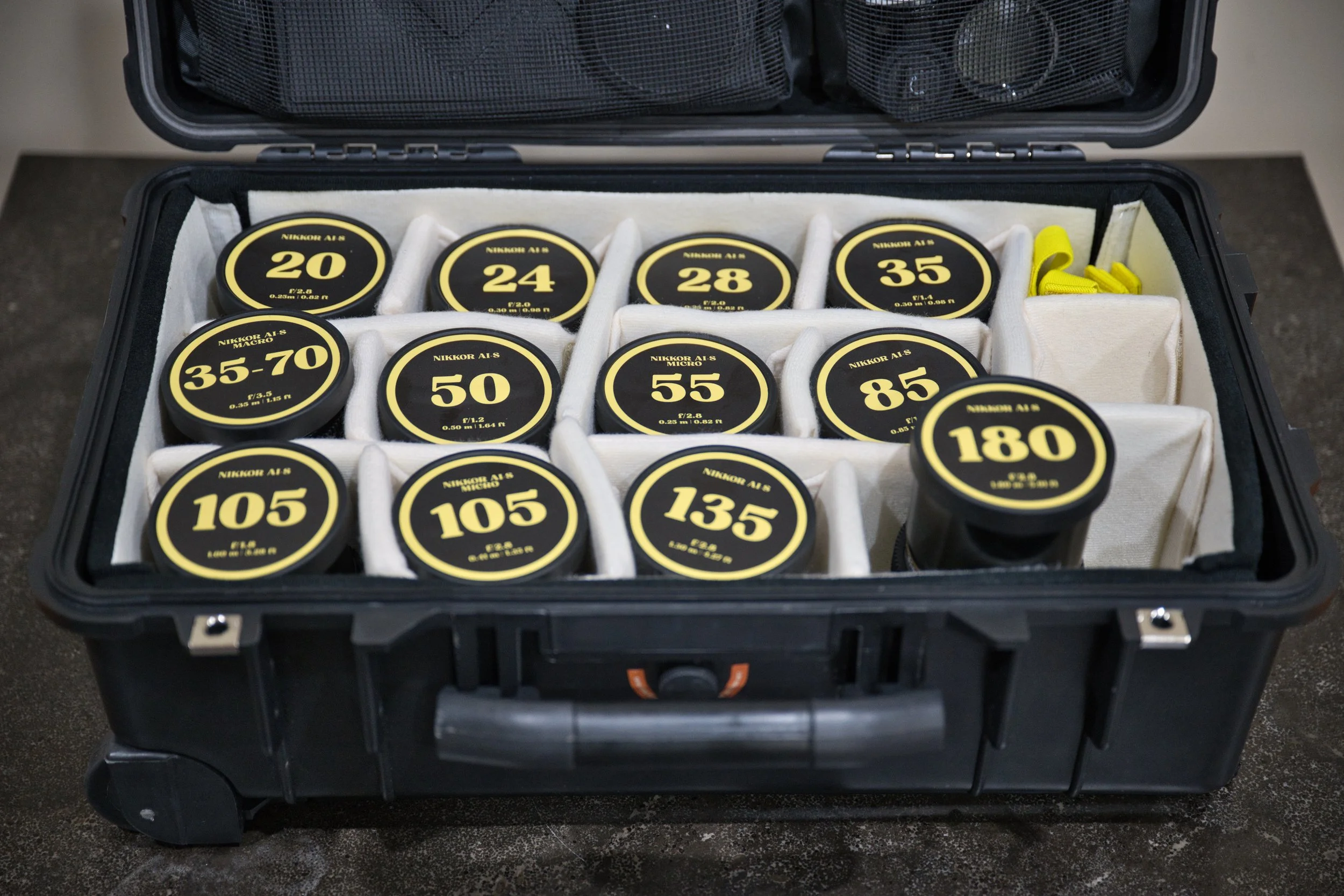
The full set lives in an Apache 5800 hard case from Harbor Freight — $99.99. It is a budget carry-on-style hard case comparable to the Pelican 1510, but not dimensionally identical. Pelican 1510-style inserts and accessories may work, but fit should be verified before purchase.
| Lens Case & Storage Setup | ||||
|---|---|---|---|---|
| Vendor | Purpose | Item | Qty | Amount Paid |
| Harbor Freight | Protective case | Apache 5800 | 1 | $99.99 |
| B&H | Case organization and moisture protection | Ruggard Adjustable Soft Divider Insert (Pelican 1510) | 1 | $54.00 |
| Ruggard Desiccant Silica Gel Pack — Metal Case (40g) | 1 | |||
| Total Case & Storage Investment | $153.99 | |||
The Ruggard divider is made for the Pelican 1510 and was selected for this Apache 5800 setup, but fit should be verified before purchase. The desiccant pack lives in the case permanently. Vintage glass and humidity do not mix. Fungus and haze are the two killers on the used market. A silica gel pack is cheap insurance against both.
Standard kit items beyond the lenses: caliper (for confirming Tilta ring sizes on location), lens visor (for on-set glare). Both travel with the case.
Custom Front Cap Labels
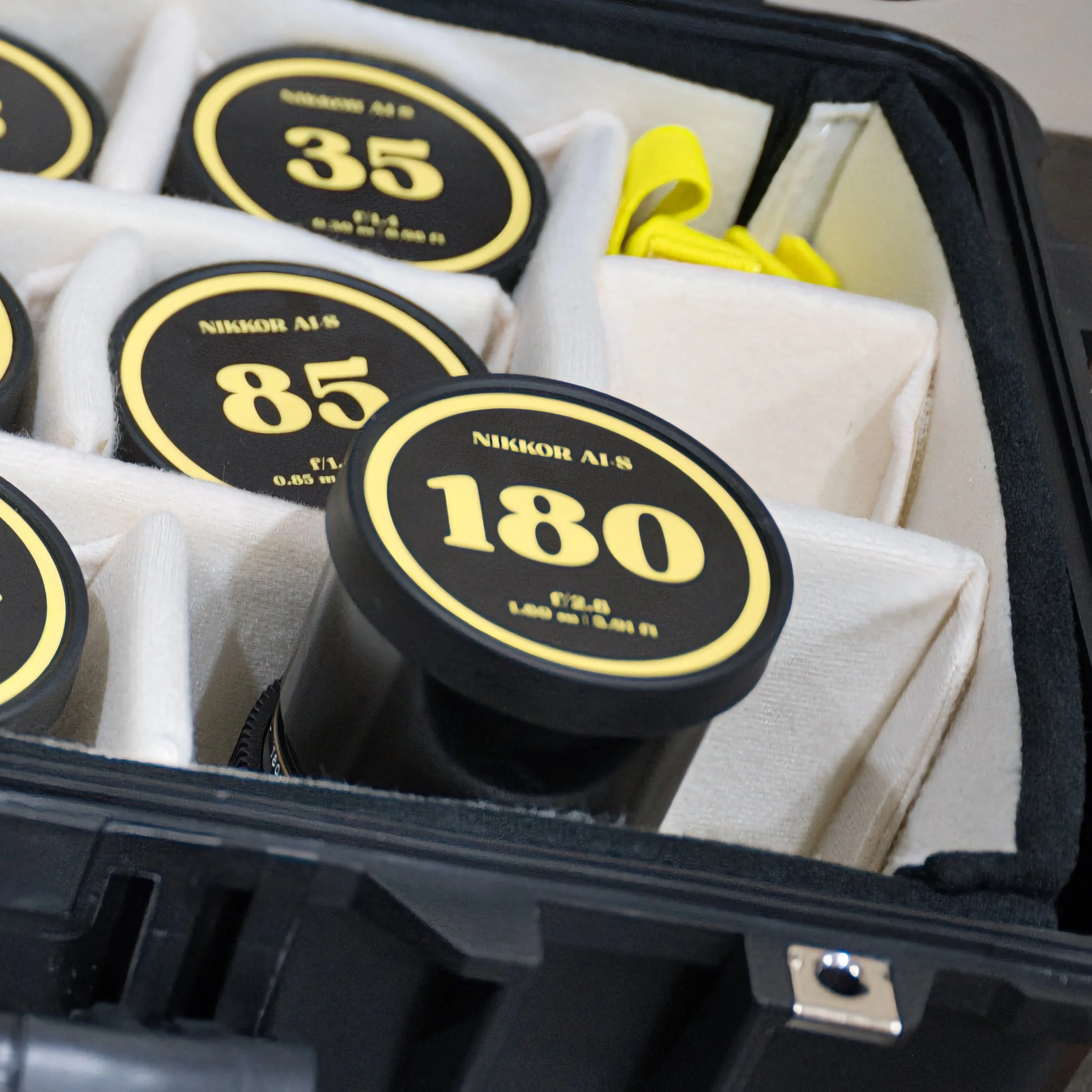
I designed a full set of custom front cap labels for all twelve lenses. The design pulls from the original Nikkor branding of the era these lenses were manufactured — black circular field, yellow text, “Nikon / Nikkor AI-S” at top, large focal length number at center, f-stop and close focus distance (metric and imperial) at bottom.
The label package includes individual labels for each lens and a “NIKKOR AI-S Vintage Cinema Set” title card with an art-deco border treatment. Files are delivered in PDF, PSD, SVG, and PNG.
I had them printed at Allegra Fairfax — print-ready PDF, no hassle.
This serves the same purpose Chumbley describes in his cap section — when twelve capped lenses are sitting on a cart, you need to identify focal lengths immediately. The labels do that, and they make the set look finished. That matters on set and it matters in the studio.
Detail of the custom cap design — Nikkor AI-S branding, focal length, max aperture, and close-focus distance in metric and imperial.
Full Cost Breakdown
| Category | Purpose | Cost |
|---|---|---|
| 12 Nikkor AI-S Lenses (A-Set) | Core vintage cinema lens set | $4,064.25 |
| Urth Nikon F to Leica L Adapter | Camera mount adaptation | $65.00 |
| Tilta Seamless Focus Gear Rings (×12) | Follow focus control | $29.43 |
| 80mm OD Step-Up Rings (×12) & Caps (×12) | 80mm front standardization and lens protection | $485.00 |
| Apache 5800 Hard Case | Protective storage case | $99.99 |
| Ruggard Divider Insert + Desiccant | Case organization and moisture protection | $54.00 |
| Total | $4,797.67 | |
The caliper and lens visor are items I already owned. If you are starting from scratch, add $15–$20 for those. Twelve vintage cinema lenses — adapted, geared, standardized to 80mm OD, capped, labeled, cased, and ready to rig — for under $5,000.
Where to Buy
Lenses. MPB and KEH for warrantied vintage glass. eBay for finding deals — but do your diligence. When reading a listing for vintage glass, look for three clear confirmations: No Fungus, No Haze, No Balsam Separation. If the seller does not explicitly confirm all three conditions, move on.
No Fungus. Fungus grows on the interior lens coatings when glass is stored in warm, humid environments without air circulation. It starts as small web-like threads visible when you shine a light through the lens. Left unchecked, it etches permanently into the coating itself — at that point, even a professional cleaning cannot restore the surface. Fungus also spreads. Put one infected lens in a case with clean glass, and the spores migrate. One bad lens can compromise an entire set. That is why the desiccant pack lives in the case permanently.
No Haze. Haze is a cloudy film on the interior surfaces of the lens elements — from outgassing of old lubricants, moisture contamination, or coatings breaking down over decades. The effect on the image is immediate: reduced contrast, washed-out highlights, and a milky quality in backlit situations. Light haze can sometimes be cleaned by a technician who disassembles the lens. Heavy haze cannot. And you will not know which kind you are buying from a listing photo. If the seller does not say “no haze,” assume the worst.
No Balsam Separation. Balsam separation happens when the optical cement between bonded lens elements deteriorates or delaminates over time, especially from heat, age, and poor storage conditions. You may see it as bubbling, cloudiness, or rainbow-like discoloration between elements that normal cleaning cannot reach. It is usually expensive to correct and often costs more than the lens is worth. It is one of the most expensive problems to miss because it can destroy contrast and introduce flare that cannot be fixed in post.
Adapter. Urth Nikon F to Leica L passive mechanical adapter. Fully manual. Good mechanical tolerance matters more than electronics with these lenses.
Focus Gears. Tilta Seamless Focus Gear Rings from B&H or Amazon (current setup). Simmod SIMple Fit gears from simmodlens.com (planned upgrade).
80mm OD Rings & Caps. FollowFocusGears.com — ask about the military discount. Cordvision and Simmod are solid alternatives.
Case. Apache 5800 from Harbor Freight ($99.99). Pelican 1510-style accessories may work, but fit should be verified before purchase. Ruggard Pelican 1510 divider insert from B&H.
Own the Tools
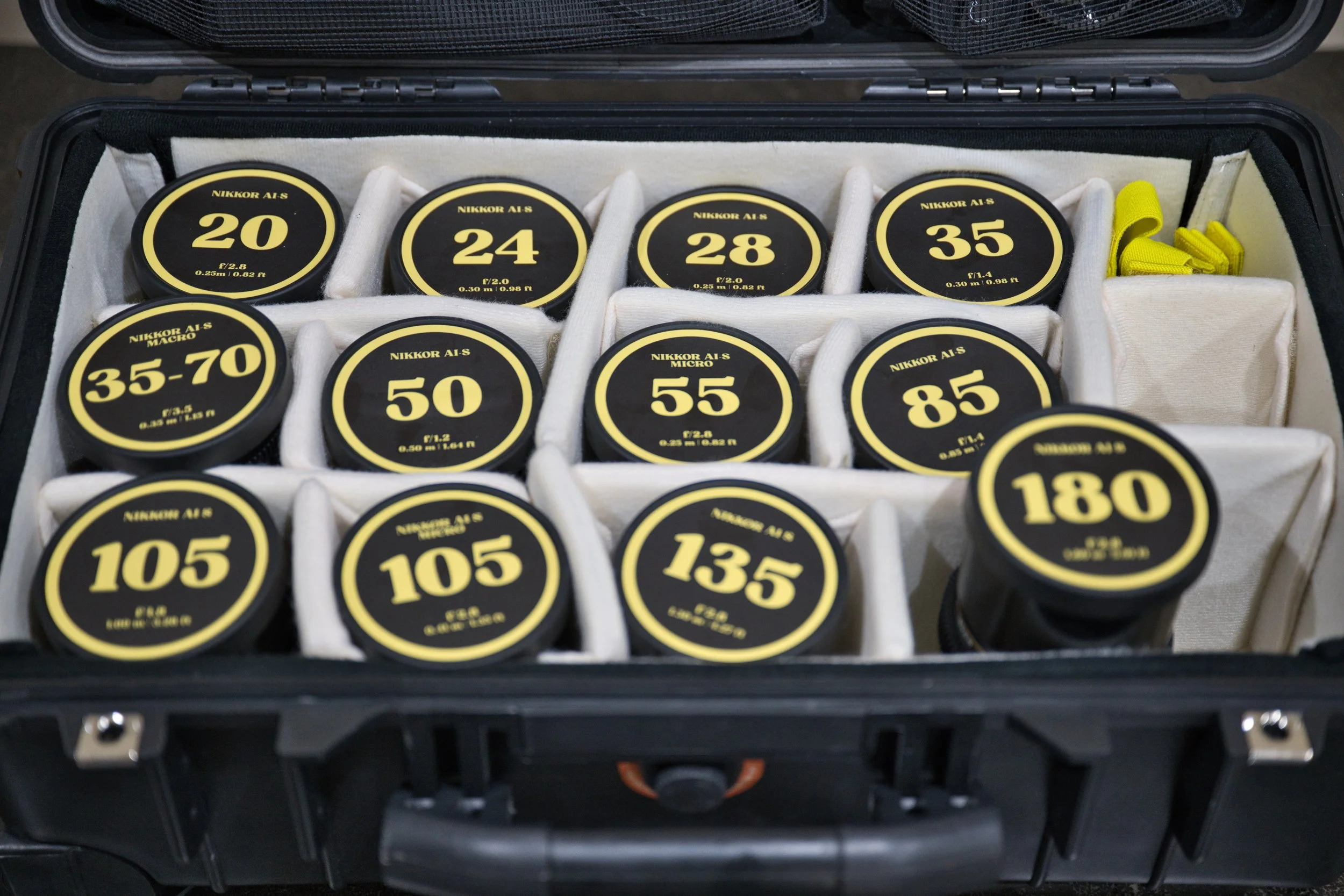
The lid open. Black circles, yellow focal lengths, 20 through 180 — the kit looking back.
Twelve lenses in an Apache case. Geared, standardized, capped, labeled. Black circles with yellow focal lengths — 20 through 180 — looking back at me every time I open the lid. Four years of buying carefully, one lens at a time, until the set was done.
I did not want to rent a look. I did not want to depend on a house package, a rental weekend, a subscription, or a firmware cycle. These lenses have no electronics, no platform dependency, no end. They work the same way they worked the day they were manufactured.
Own the tools. Understand the tools. Depend on nothing you cannot control.
I own other glass. Modern native Z-mount primes and zooms for client and production work on the ZR. Sigma and Panasonic L-mount autofocus glass for the PYXIS when the shot demands speed and precision. A Blazar Remus 1.5x anamorphic set for widescreen narrative work where the format itself carries meaning. Three systems, three jobs, all owned outright. But the Nikkors are the signature voice. When I shoot the Otherlight Universe projects, when the work needs to feel ancient and patient and real — these are what go on the PYXIS.
The case closes. It weighs what it should.
Coleman Harper is a U.S. Army veteran, filmmaker, novelist, and the founder of Blerd Corner LLC — a creative studio and publishing imprint specializing in film & video production, post-production, and brand photography. The Nikkor AI-S Vintage Cinema Set was built for narrative and brand cinematography on the Blackmagic PYXIS 6K.